What an MCA Lender Actually Does #
An MCA lender, meaning a merchant cash advance provider, gives your business a lump sum up front. In exchange, it buys a share of your future sales. You repay by letting the provider take a set percentage of your card receipts or daily bank deposits until the agreed total is paid.
Despite the name, it is usually not a loan. There is no fixed monthly payment and no interest rate on a promissory note. The provider is paid from what your business takes in, which is why the review focuses on your sales, not only your personal credit score.
The total you will repay is set when you sign. Understand that number before anything else.
How Repayment Works With Daily Sales #
Many agreements use a holdback: a percentage of daily sales set aside for the provider until the purchased amount is paid. In a strong week you pay more. In a slow week you pay less, and the balance takes longer to clear.
That flexibility helps when revenue is seasonal. It also means the term is not fixed. A slow stretch lengthens the payoff, but the total you owe stays the same.
Some providers instead debit a fixed daily or weekly amount and adjust it only if you ask. Check which kind your contract describes.
The Real Cost: Factor Rates vs. APR #
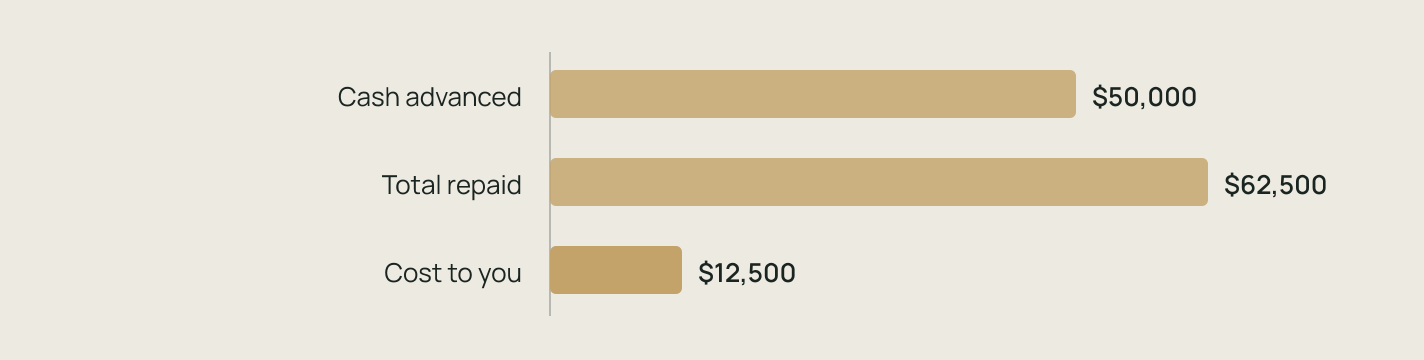
An MCA is priced with a factor rate, not an interest rate. A factor is a multiplier on the advance amount. Take $50,000 at a 1.25 factor (≈ 65-75% APR over 8 months): you repay $62,500, a $12,500 cost. On paper, that looks modest.
The trouble is timing. You repay in months, not years, so the same $12,500 becomes a much higher annual rate. Shorter terms push the rate higher still. Fees deducted from the advance before funding raise it further, because you receive less than the headline amount.
Always ask for the total dollar cost, the term and the APR in writing. Some states, including California and New York, require standardized cost disclosures before an offer is final. Even where no rule applies, ask.
Illustrative example: $50,000 advanced at a 1.25 factor (≈ 65-75% APR over 8 months). The payback is $62,500.
What Gets You Approved #
Expect to provide several months of business bank statements and, if you take cards, your processing history. The reviewer will want to know how long you have operated and whether your deposits can cover the holdback alongside your other bills.
Existing advances and loans count against you. If you already have one, a new provider may decline you or offer less, because your deposits are already promised elsewhere. The Federal Reserve's Small Business Credit Survey reports how often small firms apply for each type of financing, including online lenders, and how often they are approved.
Have your last few statements ready and a clear reason for the money. A specific use makes a clean file.
When an MCA Lender Is the Right Tool #
An MCA makes sense when the money turns into cash quickly and you can show how. Examples include stock for a confirmed order, a repair that keeps a revenue line running, or a short bridge while customer payments are on the way.
It fits when you can repay from sales within months, you have run the total cost and it still works, and a bank has said no or cannot close in time. It does not fit when the need is long-term, when your margins are thin, or when the purchase will not produce cash for many months.
When a Bank, SBA Loan or Line of Credit Is Better #
If you have strong credit and can wait, a bank or SBA loan is usually the lower-cost route. A bank term loan or SBA loans price money as an annual rate, and that rate is almost always lower than an MCA's APR. The trade-off is time and paperwork. Bank processes are built for borrowers who can wait weeks or months, and many owners who need cash this month find they cannot.
A line of credit suits recurring gaps, such as seasonal inventory, because you draw and pay interest only on what you use. Here is how the main options compare:
| Option | Typical cost | Speed | What it needs |
|---|---|---|---|
| Merchant cash advance | Factor rate; a 1.25 factor over 8 months ≈ 65-75% APR | Often days | Steady card or bank deposits |
| Bank term loan | Annual interest rate, usually the lowest of these when approved | Often weeks to months | Strong credit, time in business, financial statements |
| SBA 7(a) loan | Annual interest rate within SBA limits, usually low | Usually several weeks or longer | Full application, business plan, typically a personal guarantee |
| Line of credit | Annual interest on the amount you draw | Weeks to months to set up | Established revenue and credit, renewed periodically |
| Short term business loan | Fixed fee over a short term; ask for the APR | Often days | Recent revenue; terms vary by lender |
How to Compare Offers Before You Sign #
Put every offer on the same page. Write down the amount you will actually receive, the total you will repay, the term, the payment amount, the holdback percentage and the APR. If you are weighing short term business loans against an advance, compare the APRs side by side.
Read the default and collection terms. Check whether the contract requires a personal guarantee, whether it includes a confession of judgment clause, and what happens if your account closes or deposits stop. Regulators have acted against some merchant cash advance companies over misstated funding amounts and undisclosed personal guarantees, so check the figures against the signed paper, not the sales call.
Will an MCA Lender Still Fund a Business With Weak Credit? #
Sometimes. Approval leans on deposits, so a weaker credit score may not block an offer. But weaker credit may come with a higher factor, tighter terms or a smaller amount, and not every provider will fund. If credit is the obstacle, read about business funding without collateral to see other routes. Do not accept terms you cannot model against your monthly deposits.
Is a merchant cash advance the same as a loan? #
No. A loan has a rate, a repayment schedule and a payoff date you can plan around. An MCA buys a share of future sales, so the total is fixed but the timing moves with your revenue. The legal label matters less than the contract, so read it for what you receive, what you repay and how the holdback works.
How much does a merchant cash advance really cost? #
Subtract what you receive from what you repay. On a $50,000 advance, a 1.25 factor (≈ 65-75% APR over 8 months) costs $12,500. Because you repay in months, the annual rate runs high. Compare that APR with the other options in the table above, not the factor. Ask for the cost disclosures in writing before you sign.
What do providers require to approve a business? #
Usually several months of bank statements, card processing history if you take cards, time in business, and cash flow that can cover the holdback along with your other bills. Expect questions about existing debt and ownership. Approval leans on revenue, but existing advances and loans will be counted against you.
What happens if my sales drop during repayment? #
If your contract uses a true percentage holdback, payments shrink when deposits shrink. The total you owe does not change, so the payoff takes longer. If your contract uses a fixed daily debit, payments may not shrink unless the provider agrees to adjust them. Read the contract for what counts as default, such as missed deposits or a closed account. Tell the provider early and ask what is allowed. Free counseling through Small Business Development Centers can help you build a cash-flow plan before the slow period hits.
Where This Fits in Your Plan, and Where It Doesn't #
An advance fits a short, specific need with a clear path to cash. It does not fit a long-term investment, a thin-margin business or a need you cannot measure. If the numbers work in writing and the use is clear, start your request.
Sources #
Everything in this guide is general information, and not advice about your situation. All figures given are illustrative; the only terms that apply to you are those in the agreement you sign. What we do and where our fee comes from.