What an SBA loan actually is #
The Small Business Administration usually doesn't lend the money itself. It guarantees part of a loan that a bank or other approved lender makes to your business. If the borrower defaults, the guarantee covers part of the lender's loss. That is why banks will offer longer terms and lower rates than they might otherwise.
Three programs come up most often. The 7(a) loan is the general-purpose option, used for working capital, equipment, real estate and refinancing. The 504 loan is built for major fixed assets such as buildings and heavy equipment. The microloan is capped at $50,000 and is made through nonprofit intermediaries. Each has its own limits, so check the SBA's program pages for current rules.
The trade-off is time. The guarantee makes the loan easier for a bank to hold, but it adds a federal layer of review on top of the bank's own underwriting.
What SBA loans cost, and how to compare them #
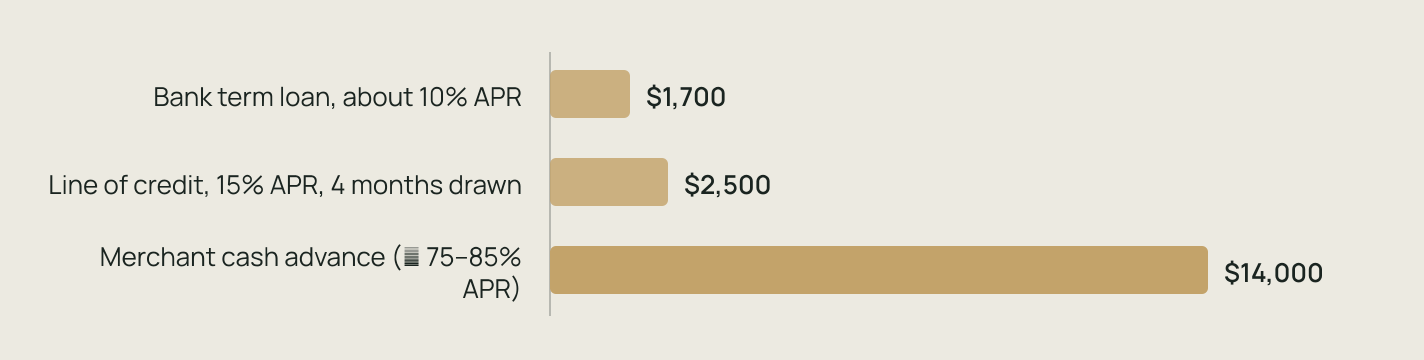
Compare every option on two numbers: the total dollars you pay and the annual rate. Don't read a factor as an annual rate. It is a multiplier. A factor of 1.28 means you repay $1.28 for every $1.00 you receive, so $50,000 becomes $64,000, a $14,000 cost. For example, that works out to roughly 75–85% APR, depending on how quickly you repay.
The table sets the options side by side. The figures are examples, not quotes.
| Option | Typical cost | Speed | What it needs |
|---|---|---|---|
| SBA 7(a) loan | Rate set by the lender within SBA caps; often among the lowest on paper | Weeks to months | Strong credit, tax returns, business plan, personal guarantee |
| SBA 504 loan | Fixed rate tied to a federal benchmark; best for real estate and equipment | Months | A major fixed-asset purchase and two lenders in the deal |
| Bank term loan | For example, about $1,700 in interest on $50,000 over 8 months, at about 10% APR | Weeks | Strong credit, financial statements, often collateral |
| Business line of credit | For example, about $2,500 if $50,000 stays drawn for 4 months at about 15% APR | Days to weeks | Time in business, steady revenue, bank statements |
| Short-term business loan | Often a factor rate; for example, 1.15 over 6 months ≈ 55–65% APR | Days | Recent bank statements showing steady deposits |
| Merchant cash advance | Factor rate; for example, 1.28 on $50,000 = $14,000 total, ≈ 75–85% APR | Often within days | Card sales or bank deposits |
Two points matter here. Interest on a term loan falls as you pay down the balance, so the dollar cost depends on how the loan is repaid. A factor-rate product usually charges its full fee whether you repay early or late, though some providers offer a reduction for early payoff. If you want to see how lenders outside the SBA price loans that don't require collateral, read about unsecured business loans.
The chart below shows the same $50,000 using the example figures from the table.
How long SBA approval really takes #
SBA approval is a sequence of steps, not one decision. The bank collects documents, underwrites the loan, sends the file through SBA review for guaranteed programs, and then closes. Each step waits on the one before it. Owners often wait several weeks, and many wait months.
Lending data supports that picture. The Federal Reserve's Small Business Credit Survey tracks how long small firms' applications take and how often they are approved. The FDIC's small business lending survey shows that approval speed varies by bank size and by whether the borrower already has a relationship with the lender.
If the money has a deadline, count backward from it and add slack. Then ask whether the deadline can survive the timeline.
Who qualifies, and what lenders will ask for #
The SBA sets program rules, but the lender sets the actual credit standard. Expect to provide personal and business credit history, time in business, business and personal tax returns, year-to-date financial statements, a debt schedule, and a business plan for larger loans. Owners of 20% or more of the company usually sign a personal guarantee.
Lenders take collateral when it's available. If you don't have assets to pledge, business funding without collateral explains what is open to you.
Free help exists. Small Business Development Centers offer counseling, including help preparing a financing request. The SBA's Lender Match tool, also free, connects you with participating lenders.
When an SBA loan is the right tool #
An SBA loan fits when the money buys something that will earn its keep for years. Examples include buying a building, financing a major equipment purchase, funding an expansion with a written plan, or refinancing expensive short-term debt into a longer, cheaper term.
It also fits when you have time. If the need is months away and your credit and paperwork are in order, the lower cost usually outweighs the wait. Separately, the SBA offers disaster loans to businesses hit by a declared disaster, which is a different program with its own application.
When to skip the SBA and use faster funding #
Skip the SBA when the cash is needed in days. A payroll run on Friday, a supplier who wants payment before a shipment, or a bill due before the next deposit are all reasons to move faster.
Faster options include a merchant cash advance, a short-term business loan, or a line of credit you already have open. Price each one in APR before you sign, not in factor rates alone. Some states, California and New York among them, now require commercial financing disclosures that spell out total cost and an annual rate. Use those disclosures to compare offers. The Federal Trade Commission has also taken action against merchant cash advance providers for misstating funding amounts and falsely claiming no personal guarantee was required. Read the contract. Watch for personal guarantees and confession-of-judgment clauses.
If the need runs a few months rather than a few days, short term business loans sit in the middle, with faster approval than an SBA loan and more predictable terms than a cash advance.
FAQ #
What is the difference between an SBA loan and a regular bank loan? #
An SBA loan is made by a bank or approved lender, but the SBA guarantees part of it. That guarantee lowers the lender's risk, which often means longer terms and lower rates than a conventional bank loan. The trade-off is process: SBA loans add federal review and documentation, so they take longer to close. A regular bank term loan has no federal guarantee, so it can move faster, but it usually asks for more collateral and may cost more.
How long does it take to get an SBA loan? #
Plan for weeks to months. The timeline includes gathering documents, bank underwriting, SBA review for guaranteed programs, and closing. Delays are common when financial statements are incomplete or tax returns are late. If you need the money within a few weeks, an SBA loan is usually too slow. Start the application early, and treat any date you cannot move as a reason to look at faster options.
What credit score and time in business do I need for an SBA loan? #
The SBA does not set one universal credit score. Lenders set their own standards within program rules, and they look at personal credit, business credit, cash flow and time in business together. Strong credit and a track record of several years help considerably. Newer businesses can qualify in some cases, but expect a tougher review and more documentation. Ask a lender directly what they require before you assemble the package.
Are SBA loans cheaper than other business funding? #
Often, yes, on an annual-rate basis. SBA loans commonly carry rates well below merchant cash advances and many short-term loans. But cheaper per year does not always mean cheaper overall, because a term loan's cost depends on how long you keep the balance. Compare total dollars paid and APR side by side, using the same term length, before deciding.
What happens if I need money faster than an SBA loan allows? #
Choose a faster product and price it carefully. A line of credit you already have open is often the quickest. A short-term business loan or merchant cash advance can fund in days, but the cost is higher, often well into the 50% to 85% APR range or more. Read the disclosure, confirm the total repayment amount, and check for personal guarantees. If the timeline allows even a few weeks, an SBA loan may still be worth the wait.
Matching the loan to your month #
Start with three questions. How soon is the cash due? What will the money earn, and does that outlast the loan? What is the all-in cost in APR?
If the cash is due within a month, an SBA loan is usually the wrong tool, even if it is the cheapest one on paper. If the money buys a long-lived asset and the deadline is months away, an SBA loan is often the best fit. Between those two cases, a line of credit or short-term loan often bridges the gap.
Next step: start your request.
Sources #
Everything in this guide is general information, and not advice about your situation. All figures given are illustrative; the only terms that apply to you are those in the agreement you sign. What we do and where our fee comes from.